 Rare Leaf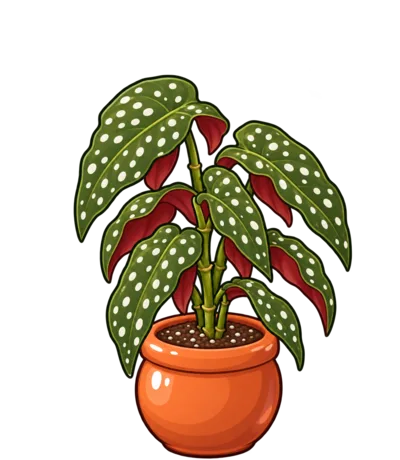
Polka Dot Begonia Care (Begonia maculata): Light, Watering and Propagation
Begonia maculata · Begoniaceae
The polka dot begonia (Begonia maculata) is an upright cane begonia with long, narrow leaves covered in silvery-white spots and backed in deep red. Its graphic look made it one of the most photographed houseplants of recent years. It is not especially fragile, but it hates soggy soil and direct sun.
How to identify a polka dot begonia
Begonia maculata is a cane-stemmed begonia: it has upright, bamboo-like stems with distinct joints that become woody with age. The RHS describes the leaves as green with silvery-white spots above and red beneath, with a heart-shaped base and a wavy margin. In summer it produces drooping clusters of pale pink or white flowers.
The RHS gives a mature height of about 20–40 inches and a spread of up to 20 inches, reached in two to five years. Besides polka dot begonia, it is also called spotted begonia or trout begonia.
It belongs to the begonia family, Begoniaceae. Kew’s Plants of the World Online gives its native range as Brazil, specifically Rio de Janeiro state. Like many begonias, it grows as a forest understory plant, which explains why it wants bright but filtered light.
Light
The RHS says cane begonias need good light for sturdy stems and plenty of flowers, but must be protected from direct sun to avoid scorched leaves. An east window is ideal, or a spot set back from a south or west window behind a sheer curtain. In low light the stems stretch and the plant gets sparse.
Watering
The RHS advises never letting the mix dry out completely while avoiding overwatering. Aim for compost that is moist but well drained. Water when the top layer starts to dry, empty the saucer, and water less in winter.
Water at the base and keep the leaves dry. NC State Extension warns that begonias are highly susceptible to root rot when overwatered and to fungal diseases, and recommends watering at the base and avoiding the leaves.
Soil and repotting
The RHS recommends a light, well-drained, peat-free potting mix, or a peat-free loam-based mix such as John Innes No. 2.
Repot in spring when the roots fill the pot, moving up only one size. A large volume of wet soil raises the risk of rot. Tall plants may need a stake or a heavier pot so they don’t tip over.
Humidity and temperature
Polka dot begonias like humid air but not wet leaves. Instead of misting, raise humidity indirectly: the RHS suggests standing the pot on a tray of gravel or clay pebbles with the water level just below the surface. Don’t overdo it, though. The RHS notes that air that is too damp and stagnant leads to rotting leaves and leaf drop.
The RHS recommends 58–72°F (15–22°C) for cane begonias and gives an optimum of about 66°F (19°C) for this species, with a winter minimum of 50–59°F (10–15°C). Keep it away from drafts and radiators.
Fertilizer
From May to September, feed established plants with a high-potassium fertilizer at the rate on the label, as the RHS recommends for cane begonias. For B. maculata specifically, the RHS suggests a balanced liquid fertilizer at every other watering. Don’t feed in winter.
Pinching and pruning
Cane begonias tend to grow tall and bare at the base. Pinching out the tips encourages branching, and you can shorten leggy stems in spring. The RHS also describes a harder cutback for cane begonias, to about 6 inches above the base, after which the plant regrows. Use the tips you remove as cuttings.
How to propagate polka dot begonia from cuttings
Begonia maculata is propagated from stem cuttings. The RHS recommends April for cane begonias.
- Cut a 3–4 inch tip cutting just below a joint (node).
- Remove the lower leaves, keeping two or three at the top.
- Insert the cutting in a sandy, peat-free cutting mix with the node below the surface.
- Keep it warm. The RHS recommends bottom heat of 64–70°F (18–21°C). A warm room and a clear cover also work; air it out daily.
- Keep it out of direct sun and the mix just lightly moist. Once it roots and starts growing, pot it up into regular mix.
Varieties
The spots are not variegation but the species’ natural pattern. The RHS also lists the form ‘Wightii’, with long, narrow green leaves, crimson-red undersides and silvery-white polka dots.
Five common mistakes
- Misting the leaves. Wet foliage invites powdery mildew and gray mold. Use a pebble tray instead.
- Watering “just in case.” Constantly wet soil is the fastest way to stem and root rot.
- A sunny south windowsill. The RHS warns that continuous direct sun scorches the leaves.
- Drafts and winter cold. Below 50–59°F the plant suffers and drops leaves.
- Too big a pot. More soil holds more water than the roots can use.
Common problems
| Symptom | Cause | Fix |
|---|---|---|
| White powdery coating on leaves | powdery mildew | remove affected leaves, improve airflow, keep leaves dry |
| Gray fuzzy mold, rotting leaves | gray mold (botrytis), overwatering, stagnant damp air | water less, ventilate, remove affected parts |
| Blackened, rotting stem base | stem and root rot | let the mix dry out, root healthy tips as cuttings |
| Leaf drop | overwatering, cold, drafts | adjust watering, keep above 59°F |
| Brown scorched patches | direct sun | move to filtered light |
| Leggy, sparse stems | too little light | brighter spot, pinch the tips |
| White cottony clusters | mealybugs | see mealybugs |
| Silvery streaks, distorted leaves | thrips | see thrips |
| Speckling, fine webbing | spider mites | see spider mites |
The RHS also lists aphids and vine weevil as pests of B. maculata.
Is polka dot begonia toxic to pets?
The ASPCA lists begonias (Begonia spp.) as toxic to dogs, cats and horses. They contain soluble calcium oxalates, and the underground parts are the most toxic. In dogs and cats the main signs are vomiting and drooling. NC State Extension rates the severity as low, notes that the sap can irritate skin, and includes children among those at risk.
Keep the plant out of reach of pets and small children, and wear gloves when you prune or repot.
Variegated & notable cultivars
- 'Wightii' — natural pattern
FAQ
How often should I water a polka dot begonia?
Never let the potting mix dry out completely, but avoid soggy soil. Water when the surface starts to dry and cut back in winter. Water at the base of the plant, not over the leaves.
Why is my polka dot begonia dropping leaves?
Overwatering, cold drafts, or air that is too damp and still, which makes leaves rot and fall, are the usual causes. Check that the soil isn't staying wet and that the plant isn't near a cold window or door.
Can Begonia maculata take direct sun?
No. The RHS says it will not tolerate continuous direct sunlight, which scorches the leaves. It needs plenty of filtered light, otherwise the stems get leggy.
Is polka dot begonia toxic to cats and dogs?
Yes. The ASPCA lists begonias as toxic to cats, dogs and horses. They contain soluble calcium oxalates, most concentrated in the underground parts, and can cause vomiting and drooling.
How do you propagate a polka dot begonia?
From stem cuttings 3–4 inches long. The RHS recommends taking them in April, inserting them in a sandy cutting mix and rooting them with bottom heat of 64–70°F (18–21°C).
Should I mist my polka dot begonia?
It is better not to. Wet leaves invite powdery mildew and gray mold. Raise humidity with a pebble tray instead.
Sources
- ASPCA — Begonia (Begonia spp.)
- RHS — Begonia maculata
- RHS — Begonias as houseplants
- RHS — Begonia maculata 'Wightii'
- NC State Extension — Begonia
- POWO (Kew) — Begonia maculata
Care information is general; every plant and home is different. Growing is simplified in the game.