 Rare Leaf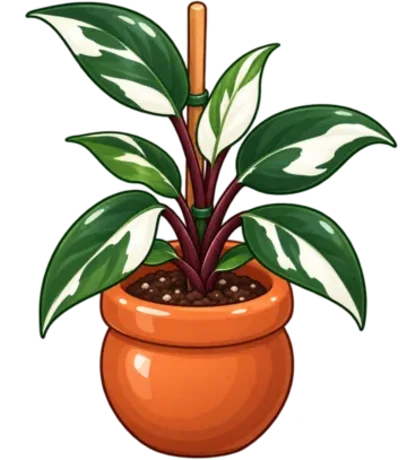
White Knight Philodendron Care: Light, Water, Support and Propagation
Philodendron 'White Knight' · Araceae
Deep green leaves with crisp white splashes and streaks, where one leaf has almost no white and the next is almost all white. Philodendron ‘White Knight’ is a variegated climbing philodendron that collectors want for exactly that unpredictability. Care is the same as for other vining philodendrons, but the white variegation makes it slower and more sensitive to sun.
What is a White Knight philodendron?
‘White Knight’ is a cultivated variety. Its parent species and breeding history aren’t documented in the major botanical databases (POWO, RHS, Missouri Botanical Garden, NParks). Some sellers list it as a cultivar of Philodendron erubescens, but no reliable botanical source confirms that, so we list it simply as Philodendron ‘White Knight’.
The genus Philodendron is native to tropical forests of Central and South America and belongs to the aroid family (Araceae), along with monstera and pothos (NC State Extension).
How to recognize it, according to grower Costa Farms:
- Leaves: dark green with bold white variegation.
- No two leaves match. One leaf may emerge with little to no white, the next with little to no green.
- Habit: climbing. Young plants make good desk plants; mature, supported plants grow larger leaves and become floor plants.
Light requirements
Costa Farms recommends medium to bright indirect light, ideally within about 3 feet of an unobstructed east- or west-facing window. It also does well under grow lights.
The white parts of the leaf lack chlorophyll and burn easily. Direct afternoon sun will scorch them. In deep shade, on the other hand, growth stalls and variegated philodendrons in general lose pattern. Aim for plenty of light without sun hitting the leaves directly.
More on reading your light levels in our houseplant light guide.
How often to water White Knight
Water when the top 1–2 inches of potting mix are dry (Costa Farms). White Knight handles drying out slightly much better than staying wet. Overwatering is the most common route to root rot, which shows up as yellowing leaves (RHS).
The RHS recommends rainwater or filtered water for philodendrons and warns against leaving the pot sitting in water. Water less in winter when growth slows.
Soil, repotting and support
Use a loose, fast-draining mix. For philodendrons the RHS recommends a slightly acidic blend (pH 5–6), such as two parts orchid mix to one part peat-free ericaceous potting mix. See our aroid soil mix guide for recipes.
Repot in spring about every two years, once roots fill the pot, and go up only one size (RHS).
Support: White Knight vines as it matures. A moss pole, totem, trellis or wall lets it climb and produce larger leaves (Costa Farms). The RHS suggests keeping a moss pole moist so the aerial roots grow into it.
Humidity and temperature
According to Costa Farms, White Knight prefers average to above-average humidity. In dry air, new leaves can unfurl deformed. Group plants together, use a humidifier or set the pot on a pebble tray.
Keep temperatures in the usual philodendron range: NC State Extension gives 65–85°F (18–29°C), and the RHS sets a minimum of 59°F (15°C). Keep it out of cold drafts and away from direct radiator heat.
Fertilizer
Costa Farms calls fertilizing optional. A general-purpose houseplant fertilizer in spring and summer is enough, either regularly or just once or twice a year. Don’t exceed the label rate; too much fertilizer burns roots.
How to propagate White Knight philodendron
Philodendrons are propagated by stem cuttings or layering (NC State Extension). The RHS method:
- Timing: spring to late summer.
- Take a cutting about 4 inches (10 cm) long with at least one leaf and one node, cutting just below the node.
- Root it in water in a warm spot with bright, indirect light.
- Pot it up in a fast-draining mix once roots have formed.
- Aftercare: keep the mix lightly moist and the air humid for the first few weeks.
Wear gloves when cutting; the sap irritates skin.
With variegated plants, choose cuttings with balanced variegation. A section with nearly all-white leaves has very little chlorophyll and tends to produce a weak plant, while an all-green section may grow out dark. Compare methods in our houseplant propagation guide.
Variegation: what to expect
On ‘White Knight’ the pattern changes from leaf to leaf (Costa Farms). Expect that:
- Very white leaves look great but give the plant less energy, so it grows more slowly.
- All-green shoots can take over if you let them. Cut them back in spring just above a node with a well-variegated leaf (the RHS recommends cutting just after a node).
- White areas brown from sun and dry air more easily than green ones.
Why variegation shifts over time is covered in our guide to variegation reversion.
Common problems
| Symptom | Cause | Fix |
|---|---|---|
| Brown, crispy white patches | direct sun | move out of direct sun or filter it with a sheer curtain |
| New leaves unfurl crinkled or torn | low humidity | raise humidity, group plants |
| Yellow leaves, wet soil | overwatering, root rot | let the top dry out; check the roots |
| Barely growing | low light, heavy variegation | more bright, indirect light; slow growth is normal for very white plants |
| New leaves all green | reversion | cut back to a leaf with good variegation |
| Webbing, fine stippling | spider mites | raise humidity, isolate and treat |
| White cottony clumps in leaf joints | mealybugs | remove by hand, isolate and treat |
NC State Extension lists mealybugs, aphids, scale, thrips and spider mites as philodendron pests. See our guides to spider mites and mealybugs.
Is White Knight toxic to pets?
Yes, it is toxic to cats and dogs. The ASPCA doesn’t list this cultivar by name; its closest entry is “Variegated Philodendron.” The toxic principle is calcium oxalate crystals. Chewing causes intense burning and irritation of the mouth, tongue and lips, excessive drooling, vomiting and difficulty swallowing.
For people, NC State Extension rates philodendrons as low severity and notes that the sap can irritate skin. Keep the plant away from kids and pets, wear gloves when pruning, and call your vet if you suspect your pet ate some.
In the game
In Rare Leaf Tycoon, Philodendron ‘White Knight’ is one of six species. You propagate cuttings from a stable or unstable mother line and only see a new leaf’s pattern once it’s revealed. Market prices shift every 12 hours, from crash to bubble. Growing is simplified in the game, and plants never die.
Variegated & notable cultivars
- 'White Knight' — unstable
FAQ
Is the White Knight philodendron rare?
Costa Farms, a major grower, describes it as a commercially rare variegated philodendron.
Why is my White Knight growing so slowly?
White sections of the leaf have no chlorophyll, so the plant makes less energy. Costa Farms notes that more heavily variegated plants grow more slowly.
Where should I put a White Knight philodendron?
In medium to bright, indirect light, ideally within about 3 feet of an unobstructed east- or west-facing window. Direct afternoon sun can burn the white areas.
Does White Knight need a moss pole?
It starts to vine as it matures. A moss pole, totem or trellis lets it climb and tends to produce bigger leaves.
Is White Knight philodendron toxic to cats?
Yes. Like all philodendrons it contains calcium oxalate crystals, which the ASPCA says cause mouth irritation, drooling and vomiting in cats and dogs.
Sources
- ASPCA — Variegated Philodendron (closest entry, genus Philodendron)
- Costa Farms — White Knight Philodendron
- RHS — How to grow philodendrons
- NC State Extension — Philodendron
Care information is general; every plant and home is different. Growing is simplified in the game.