 Rare Leaf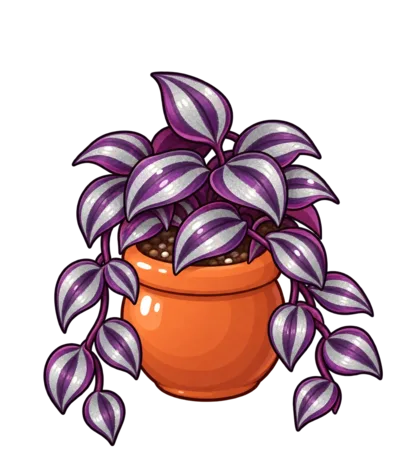
Tradescantia Zebrina Care: Light for Color, Watering and Propagating Cuttings
Tradescantia zebrina · Commelinaceae
Tradescantia zebrina, sold as inch plant, silver inch plant or wandering dude, is a fast-growing trailing houseplant with silver-striped leaves and purple undersides. It is easy to grow, roots almost anywhere, and a single cutting can fill a hanging basket within a season. Its color, though, depends almost entirely on light.
How to identify Tradescantia zebrina
The leaves are oval to lance-shaped, fleshy and clasp the stem. The Missouri Botanical Garden gives a length of up to about 2.5 inches. On top they are blue-green to bronze-green with two broad silvery stripes running lengthwise; underneath they are solid purple. The stems are succulent, branch freely and root at the nodes.
The RHS gives a height of about 6 inches, but the stems creep or trail and can spread 2 feet or more. Small, three-petaled, pinkish-purple flowers appear sporadically through the year, though rarely indoors.
It belongs to the spiderwort family, Commelinaceae. Kew’s Plants of the World Online gives its native range as Mexico to Colombia. Older books and plant tags may call it Zebrina pendula or Tradescantia pendula. The Missouri Botanical Garden notes that the common name “inch plant” is usually reserved for its relative Tradescantia fluminensis, which is why the two are often confused.
Light
This plant needs a lot of light. NC State Extension says color is most intense in full sun, although very strong southern sun can wash it out. The Missouri Botanical Garden recommends filtered sun, or direct sun with some afternoon protection. It will grow in shade, but the colors won’t be as bold.
Indoors, an east or west window is ideal, or a south window with a sheer curtain in summer.
Watering
Water regularly during the growing season, but let the soil dry out a bit between waterings. Water sparingly in winter, as both the RHS and NC State Extension recommend. Constantly wet soil leads to root and stem rot. Avoid wetting the leaves; NC State Extension notes that crowded plants with wet foliage are prone to fungal leaf spot.
Soil and repotting
The RHS recommends a peat-free, loam-based potting mix; the Missouri Botanical Garden suggests a peaty, soil-based mix. What matters most is good drainage and a pot with a drainage hole.
Because it grows so fast and older stems get bare at the base, it often makes more sense to refresh the plant than to keep moving it into bigger pots. Root fresh cuttings and plant them densely in new mix.
Humidity and temperature
Average household humidity is fine, and it tolerates higher humidity too. NC State Extension gives an ideal temperature of 65–75°F. The RHS rates it H1c, tolerating roughly 41–50°F (5–10°C); indoors, it’s safer to keep it above 50°F.
Fertilizer
Feed monthly with a balanced liquid fertilizer during active growth, as the RHS recommends. Don’t feed in winter.
Pinching and cutting back
Regular trimming matters more for this plant than for most. The RHS recommends trimming to promote thick growth and strong shoots with bold foliage. The Missouri Botanical Garden suggests pinching stems as needed and, if necessary, cutting the plant back hard in very early spring.
Every piece you trim off that has a node is a ready-made cutting, so don’t throw them away.
Summer outdoors
Both the RHS and the Missouri Botanical Garden say it can go outside for the summer. In a window box or hanging basket on a partly shaded patio, the extra light usually brings out stronger color than indoors. In frost-free climates it is grown as a groundcover, with trailing stems that root at the nodes.
Move it outside after the last cool nights and bring it back in before nights drop to about 50°F. Before it comes inside, check the leaf undersides and stem joints for aphids and spider mites.
How to propagate Tradescantia zebrina
The RHS recommends tip cuttings in spring or summer, rooted in either cutting compost or water.
- Snip a tip cutting with several nodes.
- Strip the lower leaves so only bare nodes go into the water or soil.
- In water: stand the cutting in a glass with the nodes submerged. In soil: push it into moist cutting mix.
- Keep it in bright light out of harsh sun. The stems root readily at the nodes.
- Plant several cuttings per pot for a full plant right away.
Variegated Tradescantia zebrina cultivars
- ‘Quadricolor’: the RHS describes leaves striped lengthwise with green, cream, pink and white, and recommends removing any plain green shoots that appear.
- ‘Burgundy’: dark purple leaves, according to NC State Extension.
The RHS also lists other cultivars such as ‘Tikal’ and ‘Violet Hill’.
Common problems
| Symptom | Cause | Fix |
|---|---|---|
| Faded leaves, weak stripes | too little light | move to your brightest spot, some sun is fine |
| Long, bare, leggy stems | low light, aging plant | pinch tips, cut back, restart from cuttings |
| Mushy stems at the base | constantly wet soil | let it dry out, root healthy tips |
| Brown spots on leaves | fungal leaf spot from wet foliage, crowding | water the soil, not the leaves, thin the plant |
| Plain green shoots on ‘Quadricolor’ | reversion | remove them where they join the stem |
| Speckling, fine webbing | spider mites | see spider mites |
| White cottony clusters | mealybugs | see mealybugs |
| Silvery streaks | thrips | see thrips |
The RHS and the Missouri Botanical Garden also list aphids, and NC State Extension and the Missouri Botanical Garden list scale and whiteflies.
Is Tradescantia zebrina toxic to pets?
The ASPCA doesn’t have a separate entry for Tradescantia zebrina. It lists the related Tradescantia fluminensis (inch plant) as toxic to dogs, cats and horses, with dermatitis as the main sign.
NC State Extension rates Tradescantia zebrina as low in toxicity and lists dogs, cats and children as at risk. Eating it can irritate the mouth and stomach, and contact with the sap can cause skin irritation and redness. The RHS lists it as a skin allergen. Wear gloves when trimming and hang it out of your pets’ reach.
Variegated & notable cultivars
- 'Quadricolor' — unstable
FAQ
Why is my Tradescantia zebrina losing its color?
Almost always because of low light. NC State Extension notes that the best color develops in full sun. Indoors, give it your brightest spot, with some protection from harsh midday summer sun.
How do I make a leggy wandering dude fuller?
Pinch the stem tips regularly and cut back long, bare stems. The Missouri Botanical Garden says plants can be pruned hard in very early spring. Root the trimmings and plant them back into the same pot.
Can you propagate Tradescantia zebrina in water?
Yes. The RHS says tip cuttings root in water or cutting compost in spring or summer. Remove the lower leaves, keep the nodes submerged, and pot the cutting up once it has roots.
Is Tradescantia zebrina toxic to cats and dogs?
NC State Extension rates it low in toxicity but lists dogs, cats and children as at risk. Eating it can irritate the mouth and stomach, and the sap can cause skin irritation and redness.
Is wandering dude the same as inch plant?
Tradescantia zebrina is sold under both names. The Missouri Botanical Garden notes that the name inch plant is usually reserved for its relative Tradescantia fluminensis.
Sources
- NC State Extension — Tradescantia zebrina (toxicity)
- RHS — Tradescantia zebrina
- Missouri Botanical Garden — Tradescantia zebrina
- RHS — Tradescantia zebrina 'Quadricolor' (v)
- ASPCA — Inch Plant (Tradescantia fluminensis)
- POWO (Kew) — Tradescantia zebrina
Care information is general; every plant and home is different. Growing is simplified in the game.