 Rare Leaf
Pink Princess Philodendron Care: Keep the Pink and Stop Reversion
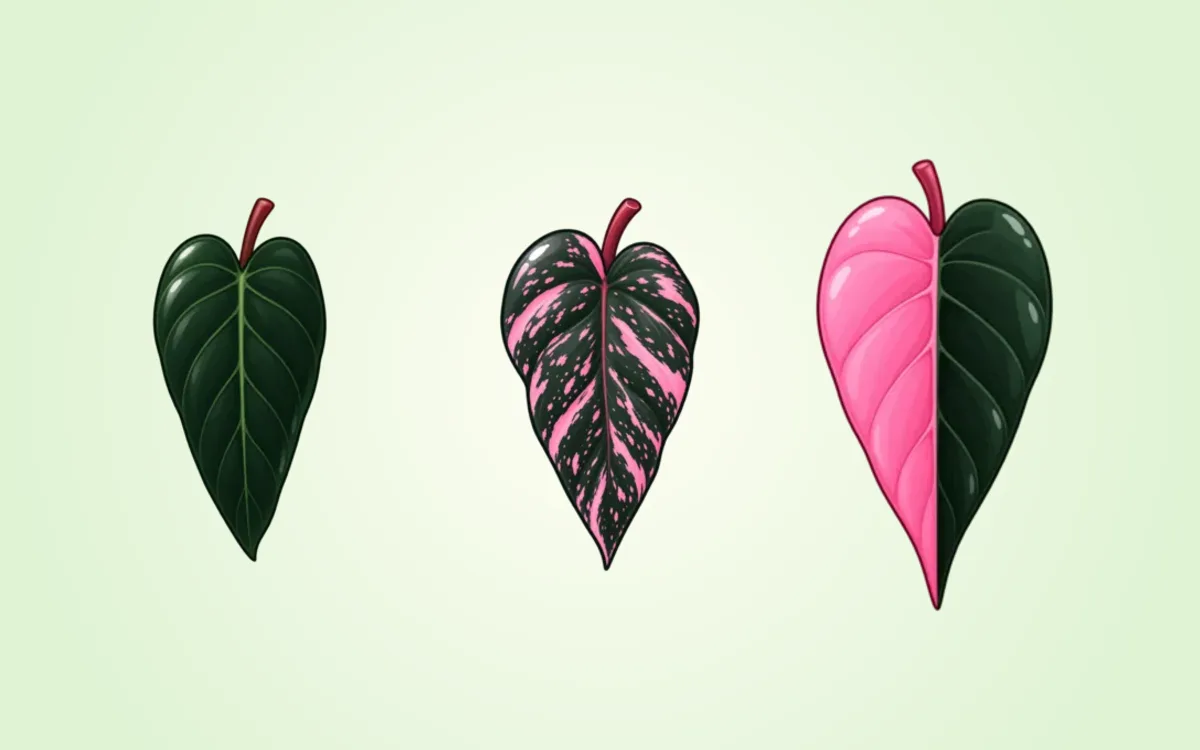
Dark green, almost black leaves with pink speckles, streaks, and sometimes a whole pink half. Philodendron erubescens ‘Pink Princess’ is one of the most photogenic houseplants around, and one of the most disappointing when it starts to turn dark.
Here’s how to keep the pink, what to do when it fades, and what to look out for when buying.
Meet the Pink Princess
‘Pink Princess’ is a cultivar of Philodendron erubescens, the blushing philodendron. NC State Extension gives its native range as Colombia. The cultivar has an upright, vining habit and heart-shaped, dark purplish-green leaves with pink variegation. Singapore’s NParks notes its reddish stems and glossy, leathery leaves.
The contrast is the whole point. The pink shows up so strongly because it sits against very dark foliage.
Why the pink is unstable
The pink sections work like the white areas on other variegated plants: they contain little or no chlorophyll, so they add color but not food. Like most collector variegation, the pattern is unstable. University of Florida horticulturists explain that plants with chimeral variegation can revert to all-green or all-non-pigmented growth and need regular pruning to keep the variegation. On a Pink Princess, that means the plant can:
- produce leaves with nicely balanced pink,
- gradually darken and revert toward almost entirely green-black leaves,
- produce an almost completely pink leaf.
Every new leaf is a bit of a surprise. That’s why collectors choose cuttings based on the pink on the stem and at the node, not just on one pretty leaf. Our guide to variegated houseplants explains the biology in more detail.
Pink Princess care
Light
This is the single biggest factor. Pink Princess needs plenty of bright, indirect light. NParks recommends bright, indirect sunlight and warns that direct sun damages the leaves. NC State likewise advises avoiding direct sunlight. In too much shade, the plant tends to produce more green, which helps it survive but costs you the pink.
A spot near an east-facing window, or set back from a south- or west-facing one, usually works well. Our houseplant light guide explains how to read the light in your room.
Watering
NParks suggests watering when about the top 5 cm (2 inches) of soil has dried out, and making sure the pot drains freely. Never let the plant sit in standing water. NC State notes that overwatering risks root rot. In winter, when growth slows, the soil will take longer to dry. Water by checking the soil, not by the calendar. See how to water houseplants.
Soil
Use a loose, fast-draining mix that still holds some moisture, like the chunky mixes used for most aroids. Our aroid soil mix guide has recipes.
Temperature and humidity
NC State lists a preferred range of 65–85°F (about 18–29°C) and recommends protecting the plant from cold drafts. High humidity is ideal, but NC State notes the plant will manage with less. An average heated home is usually fine. If new leaves struggle to unfurl, raising humidity can help. See our humidity guide.
Support
Pink Princess is a climbing philodendron. Give it a stake or moss pole. Plants that climb tend to produce larger leaves, and larger leaves give the variegation more room to show.
When your Pink Princess turns dark
- Add light. Often, moving the plant closer to a window is enough.
- Prune above a good leaf. If the top of the stem is only producing dark leaves, cut it just above a leaf that had nice pink variegation. NParks recommends exactly this, pruning just above a variegated leaf, to help keep the variegation balanced. The new shoot will grow from the node below the cut. The RHS gives the same advice for reverted shoots on any variegated plant.
- Propagate the top. The piece you cut off can become a new plant. NParks says stem cuttings work best, each with at least one leaf and one node, and that rooting takes about 4–5 weeks, faster in high humidity. Just expect that a dark node will most likely grow into a dark plant.
All-pink leaves: beautiful, but a warning
A completely pink leaf looks like treasure. However, with little or no chlorophyll, it barely photosynthesizes. It doesn’t feed the plant and usually browns over time. If a plant produces mostly pink leaves, it weakens. Growers then cut it back to a node with more balanced variegation.
Enjoy the occasional pink leaf, but don’t try to push the plant toward more of them.
Common Pink Princess problems
| Symptom | Likely cause | Fix |
|---|---|---|
| New leaves dark, little or no pink | Not enough light, or reverting stem | More bright, indirect light; prune above a well-variegated leaf |
| Pink patches turning brown and crispy | Direct sun, or all-pink tissue failing | Move out of direct sun; trim dead tissue |
| Yellowing lower leaves, soggy soil | Overwatering, poor drainage | Let the top 2 inches dry; check drainage holes |
| Small leaves, long gaps between them | Low light, no support | Brighter spot; add a moss pole |
| Leaves struggling to unfurl | Dry air | Raise humidity |
For more on leaf color problems, see our guide to yellow and brown leaves on houseplants.
Choosing a Pink Princess to buy
Because the pink is unstable, the plant you buy matters more than any care trick. When comparing plants or cuttings:
- Look at the stem, not just the leaves. Pink streaks on the stem near the top node suggest the next leaves can carry pink too. A fully dark stem is a gamble.
- Prefer balance over extremes. A plant with several leaves that mix pink and dark green is a safer bet than one with a single spectacular all-pink leaf.
- Check the newest leaf. If the latest leaves are darker than the older ones, the plant may already be reverting.
- For cuttings, insist on a node. NParks notes that a cutting needs at least one leaf and one node. A leaf alone won’t grow.
Beware of “Pink Congo”
A few years ago, Philodendron ‘Pink Congo’ appeared on the market with leaves that were entirely pink. In summer 2019, it became widely known that the color wasn’t natural variegation. It was chemically induced and temporary, and the plants eventually went back to ordinary green growth. Which chemical was used has never been clearly documented, and some popular explanations have been disputed.
The practical lesson is simple: if a plant has every leaf evenly and perfectly pink, be cautious. Genuine Pink Princess variegation is irregular and varies from leaf to leaf, and the plant always has dark green leaves in the mix. Our guide to buying rare houseplants covers more red flags.
Is Pink Princess toxic to pets?
Treat it as toxic. The ASPCA doesn’t list Philodendron erubescens by name, but it lists several philodendrons, including heartleaf philodendron, as toxic to cats and dogs because of insoluble calcium oxalates. NC State Extension lists calcium oxalate crystals in P. erubescens, which can cause mouth and stomach irritation, and notes that the sap may irritate skin. See our list of houseplants toxic to cats and dogs and our Pink Princess plant profile.
In the game
In Rare Leaf Tycoon, Philodendron ‘Pink Princess’ is the third species you unlock. As with real plants, you only see a new leaf’s pattern once it’s revealed. A rare half-moon is worth selling when the market is in a bubble. Or you can keep it for your herbarium.
FAQ
Why is my Pink Princess losing its pink?
Its pink variegation is unstable, so the plant can start producing dark, mostly green leaves. More bright, indirect light helps, and pruning just above a leaf with good pink variegation encourages a new shoot from a variegated node.
Is an all-pink leaf a good sign?
It looks stunning, but a leaf with little or no green cannot feed the plant and often browns over time. A plant with balanced pink and green grows more strongly.
What is the difference between Pink Princess and Pink Congo?
Pink Princess has genuine, if unstable, variegation. Pink Congo plants were sold with fully pink leaves that turned out to come from a treatment, not genetics, and the plants went back to producing green leaves.
Does Pink Princess need direct sun?
No. It needs lots of bright, indirect light, but direct sun damages the leaves, and the pink areas burn first.
How often should I water a Pink Princess philodendron?
There is no fixed schedule. Singapore NParks suggests watering when the top 5 cm (about 2 inches) of soil is dry, in a pot that drains well so the roots never sit in water.
Is Pink Princess toxic to cats and dogs?
Yes, treat it as toxic. NC State Extension lists Philodendron erubescens as containing calcium oxalate crystals, and the ASPCA lists several philodendrons as toxic to cats and dogs.
Sources
- NParks Flora & Fauna Web — Philodendron 'Pink Princess'
- NC State Extension — Philodendron erubescens
- RHS — Reversion in plants
- University of Florida IFAS PropG — Chimeras
- ASPCA — Heartleaf Philodendron
- Tradescantia Hub — 'Pink Congo', misinformation, and the downsides of global plant distribution
Care information is general; every plant and home is different. Growing is simplified in the game.