 Rare Leaf
Pothos vs. Philodendron: How to Tell Them Apart (Petiole, New Leaves, Roots)
The fastest way to tell pothos (Epipremnum aureum) from heartleaf philodendron (Philodendron hederaceum) is the petiole: pothos petioles have a groove along the top, and philodendron petioles don’t. Philodendron also pushes out every new leaf from a thin sheath that turns brown and falls away, while a new pothos leaf simply unfurls from the stem at the base of the previous leaf. Leaf shape and color are less reliable, because both plants have heart-shaped leaves and both come in plain green and variegated forms.
Mixing them up is completely normal. Both are aroids, both trail off shelves, and garden centers often sell them side by side, sometimes under the same generic label. Below are the ID clues that work even on a small plant in a nursery pot, followed by the care differences that come with them.
Pothos vs. philodendron at a glance
| Pothos (Epipremnum aureum) | Heartleaf philodendron (Philodendron hederaceum) | |
|---|---|---|
| Petiole | grooved along the top | no groove |
| New leaves | unfurl from the stem at the previous leaf, lighter green | emerge from a thin sheath that browns and drops; young leaves often bronze or pinkish |
| Leaf shape | heart-shaped to egg-shaped, often slightly folded along the midrib | evenly heart-shaped |
| Leaf surface | glossy, leathery, waxy, can feel slightly bumpy | glossy and smooth; velvety in ‘Micans’ |
| Aerial roots | one small root per node (per Illinois Extension) | several roots per node (per Illinois Extension) |
| Light | tolerates shade but needs a bit more light | tolerates very low light |
| Temperature | prefers it warmer | handles more variable temperatures |
| Pet toxicity (ASPCA) | toxic to cats and dogs | toxic to cats, dogs, and horses |
How do you tell pothos from philodendron by the petiole?
The petiole is the stalk that connects the leaf blade to the vine. On pothos, it has a clear groove running along the top, almost like a channel. On heartleaf philodendron, there’s no groove. NC State Extension uses this to separate the two species, and Clemson University and University of Illinois Extension point to the same feature.
Why start here? The petiole doesn’t change with the cultivar. Whether you have a green, neon-yellow, or white-marbled plant, a pothos petiole is still grooved. Pinch a leaf stalk and run your finger along it from the leaf to the vine.
How do new leaves grow on pothos vs. philodendron?
Your second reliable clue is at the tip of the vine.
Philodendron protects each new leaf in a thin, waxy sheath. University of Illinois Extension calls it a cataphyll, while NC State Extension describes large, free, lance-shaped stipules on new growth. Once the leaf opens, the sheath turns brown, dries out, and eventually falls off. Illinois Extension says new philodendron leaves are pinkish or brownish, and NC State describes them as emerging bronze and quickly turning green.
Pothos has no sheath. The new leaf unfurls straight from the stem at the previous leaf and is a lighter green than the older foliage. So if you see a dry brown sheath at the growing tip, you’re almost certainly looking at a philodendron.
Do pothos and philodendron leaves look different?
A little, but leaf shape alone won’t settle it.
- Pothos: NC State describes the leaves as heart-shaped to elliptic-ovate, glossy, and leathery. Clemson notes they’re folded along the midrib, and Illinois Extension mentions a waxy, slightly raised or bumpy texture.
- Heartleaf philodendron: leaves are evenly heart-shaped, glossy, and smooth. UF/IFAS calls them olive green and “perfectly heart-shaped.” NC State says the undersides can be green or red-purple.
When you’re shopping, trust the petiole and the new leaf over the overall look. Leaf shape shifts with age, light, and cultivar.
Can you tell them apart by the aerial roots?
Both plants form aerial roots at the nodes and use them to cling to trees in the wild. The RHS describes fleshy aerial roots on pothos, and NC State calls them brown. According to the RHS, a climbing philodendron will root into a moss pole if you keep the pole moist.
The difference University of Illinois Extension points out: pothos usually has one small root per node, and philodendron has several. It’s a handy extra clue, but it won’t help on young plants that haven’t formed roots at the nodes yet. Use it to confirm, not as your main test.
Is Philodendron Brasil a pothos? What about Micans and Lemon Lime?
This is where most of the confusion comes from, because some philodendron cultivars look very pothos-like, and the reverse is also true.
- ‘Brasil’ is a heartleaf philodendron cultivar. NC State describes it as having a yellow to light green center stripe with dark green borders. The variegation makes people think “pothos,” but the petiole has no groove.
- ‘Micans’ is the velvet-textured form of heartleaf philodendron, according to Clemson University. NC State lists Philodendron micans among the former names of P. hederaceum. A velvety leaf rules out pothos, which has glossy leaves.
- ‘Lemon Lime’ is a philodendron with bright yellow to chartreuse foliage (NC State). It’s easy to confuse with pothos ‘Neon’, which NC State also describes as having yellow leaves. Check the petiole and the new-leaf sheath.
- ‘Marble Queen’, ‘Jade’, ‘Pearls and Jade’, ‘Snow Queen’, and ‘Njoy’ are all pothos cultivars (NC State).
The general rule: a store label proves nothing. Plenty of plants are sold simply as “pothos” or “philodendron,” and the word pothos also turns up on plants from entirely different genera. For tips on checking sellers and labels, see our guide to buying rare houseplants.
Satin pothos isn’t a pothos
Scindapsus pictus is sold as satin pothos, silk pothos, or silver pothos. NC State places it in its own genus, Scindapsus, and notes it was once known as Pothos argyraeus. Its leaves are matte and satiny with silver-gray blotches, and the undersides have no blotches. Read more in our Scindapsus pictus profile.
Is pothos care different from philodendron care?
The basics are the same. Both grow in a well-drained mix, both can climb a pole or trail from a hanging basket, and both root easily from cuttings. The differences are in the details.
Light
- Philodendron tolerates very low light, according to both Illinois Extension and Clemson. UF/IFAS notes that most philodendrons survive low light but need more of it to keep their color and leaf size. The RHS adds that a philodendron short on light gets leggy and produces fewer, smaller leaves.
- Pothos does best in bright light without direct sun and can tolerate some shade, per the RHS. Too little light, though, means poor growth and faded variegation. Illinois Extension notes that variegated pothos needs more light to keep good markings.
Neither belongs in harsh direct sun; the RHS warns of scorched leaves for both. More in our houseplant light guide.
Watering
- Pothos: the RHS says to water only once the potting mix is approaching dryness. UF/IFAS says pothos indoors does better kept “a little on the dry side.”
- Philodendron: the RHS says to wait until the top of the mix dries out. NC State and Clemson recommend keeping the soil evenly and slightly moist but never soggy, and watering less in winter.
In short, pothos handles longer dry spells, and philodendron prefers steadier moisture. Overwatering either one leads to root rot. See how to water houseplants for how to check the mix before you water.
Temperature and humidity
Clemson and Illinois Extension both say pothos needs warmer temperatures than philodendron. The RHS recommends 65–86°F (18–30°C) for pothos, away from cold drafts. For philodendron, the RHS gives a minimum of 59°F (15°C), and Clemson recommends 70–85°F during the day and 65–75°F at night.
Neither needs high humidity. The RHS says pothos copes fine with typical indoor humidity, and that philodendrons adapt well to normal household levels.
Propagation
Both root from stem cuttings with a node, in water or in potting mix (RHS). UF/IFAS notes that commercial growers propagate heartleaf philodendron from short single-node cuttings with a leaf attached. Our step-by-step guide on how to propagate pothos works the same way for heartleaf philodendron.
Are pothos and philodendron toxic to cats and dogs?
Yes, both are. The ASPCA lists golden pothos (Epipremnum aureum) as toxic to dogs and cats, and heartleaf philodendron (Philodendron hederaceum) as toxic to dogs, cats, and horses. Both contain insoluble calcium oxalates. According to the ASPCA, signs include mouth irritation and burning, excessive drooling, vomiting, and difficulty swallowing, and for philodendron also swelling of the mouth, tongue, and lips.
So telling them apart won’t change whether a plant is safe around pets. The RHS recommends wearing gloves when handling either one, because the sap can irritate skin. For a wider list, see houseplants toxic to cats and dogs.
A quick ID checklist
- Run a finger along the petiole. A groove means pothos.
- Check the growing tip. A dry brown sheath at the new leaf means philodendron.
- Look at the nodes. One small root points to pothos, several roots to philodendron.
- Touch a leaf. Velvety means philodendron ‘Micans’. Matte with silver blotches means Scindapsus.
For full care profiles, see pothos and heartleaf philodendron.
In the game
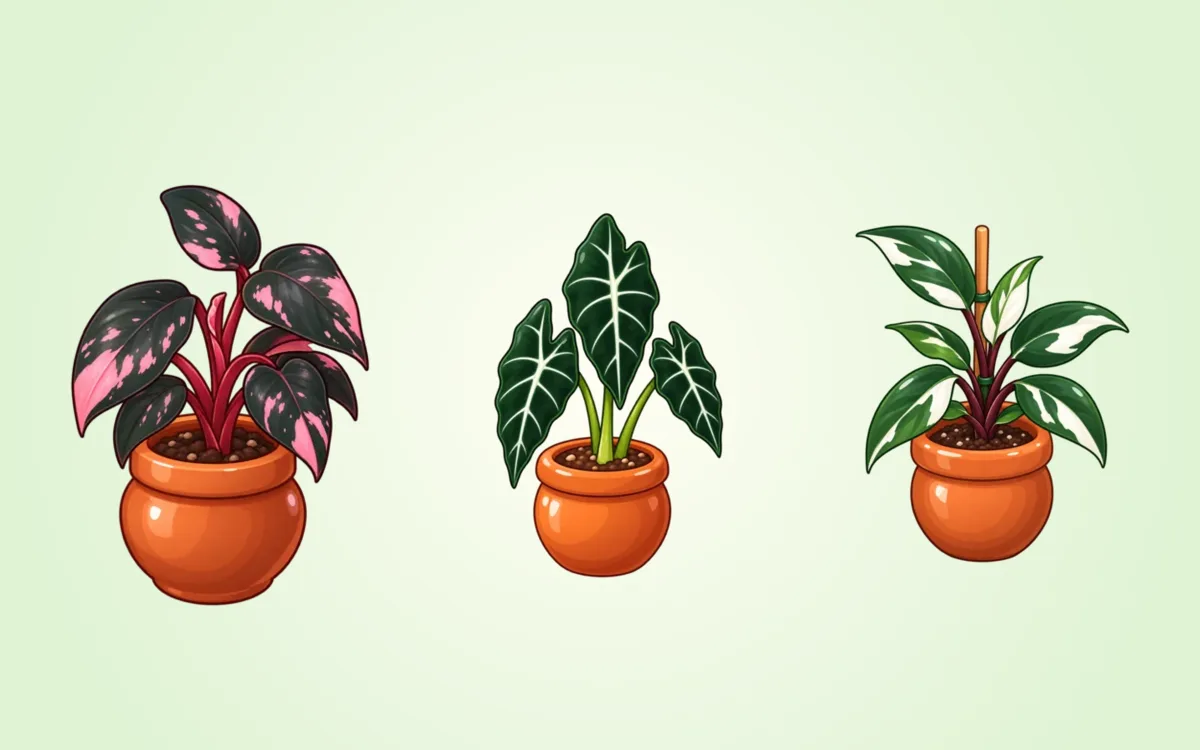
Rare Leaf Tycoon features Pothos ‘Marble Queen’ and two philodendrons, ‘Pink Princess’ and ‘White Knight’. Growing is simplified in the game and plants never die. Just like with real cuttings, though, you don’t know what pattern a new leaf will have until you reveal it.
FAQ
What is the easiest way to tell pothos from philodendron?
Look at the petiole, the stalk that attaches the leaf to the vine. Pothos petioles have a groove running along the top, and heartleaf philodendron petioles do not. The second clue is the thin sheath that wraps each new philodendron leaf.
Is Philodendron Brasil a pothos?
No. 'Brasil' is a cultivar of heartleaf philodendron (*Philodendron hederaceum*) with a yellow to light green stripe down the center of the leaf. The variegation makes it look like a pothos, but its petioles have no groove.
Is Philodendron Micans a pothos?
No. 'Micans' is the velvet-leaved form of heartleaf philodendron, once listed as *Philodendron micans*. Pothos leaves are glossy, not velvety.
Is satin pothos a real pothos?
No. Satin pothos is *Scindapsus pictus*, a separate genus from true pothos (*Epipremnum aureum*). It has matte, satiny leaves with silver-gray blotches.
Are pothos and philodendron toxic to cats and dogs?
Yes. The ASPCA lists both as toxic to cats and dogs, and heartleaf philodendron as toxic to horses too. Both contain insoluble calcium oxalates, which can cause mouth irritation, drooling, vomiting, and difficulty swallowing.
Which one does better in low light?
University of Illinois Extension and Clemson University both say heartleaf philodendron tolerates very low light. Pothos needs a bit more light, especially variegated cultivars that need it to keep their markings.
Sources
- NC State Extension — Epipremnum aureum (grooved petioles, aerial roots, cultivars)
- NC State Extension — Philodendron hederaceum (stipules on new growth, 'Brasil', former names)
- NC State Extension — Scindapsus pictus
- University of Illinois Extension — Is it philodendron or pothos?
- Clemson University HGIC — Philodendron, Pothos & Monstera ('Micans', care differences)
- RHS — How to grow epipremnum
- RHS — How to grow philodendrons
- UF/IFAS EDIS — Cultural Guidelines for Interiorscape Philodendron (EP150)
- UF/IFAS EDIS — Cultural Guidelines for Interiorscape Epipremnum (EP151)
- ASPCA — Golden Pothos
- ASPCA — Heartleaf Philodendron
Care information is general; every plant and home is different. Growing is simplified in the game.