 Rare Leaf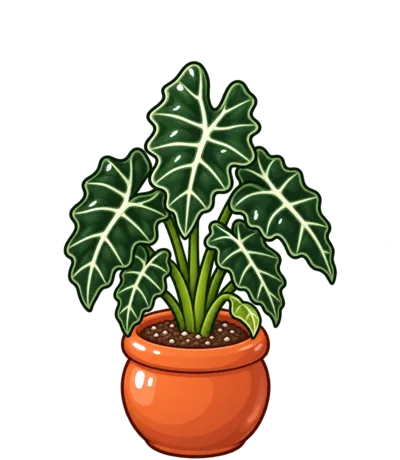
Alocasia Polly Care (African Mask Plant): Light, Water, Dormancy and Propagation
Alocasia × amazonica 'Polly' · Araceae
Glossy, shield-shaped dark green leaves with bold silvery-green veins and purple undersides. Alocasia ‘Polly’, often called the African mask plant, is a compact alocasia the RHS names as one of the most widely available. It fits on a windowsill or shelf and looks dramatic, but it needs warmth, humid air and a winter rest.
What is Alocasia Polly? Naming explained
It’s sold as Alocasia × amazonica ‘Polly’, and that’s the name the RHS uses. The ”×” marks a hybrid. The botany behind the name is a bit tangled:
- NC State Extension and NParks treat A. × amazonica as a synonym of the hybrid Alocasia × mortfontanensis. That hybrid was created by crossing A. longiloba with A. sanderiana at the nursery of French horticulturist Chantrier in Mortefontaine, and was published in 1891.
- NParks also notes that A. × amazonica was bred in Florida in the 1950s and that its parentage is disputed: some say it’s the same cross, others propose A. sanderiana × A. watsoniana.
None of this changes how you care for it. What matters is that ‘Polly’ is a cultivated hybrid, not a wild species.
How to recognize it, according to the RHS:
- Leaves: large, shield-shaped, dark green with contrasting silvery-green veins and purple undersides.
- Size: compact, up to about 1.5 feet tall and wide; NC State Extension says up to 2 feet.
- Growth: reaches mature size in one to two years.
- Flowers: occasional, with a yellow spathe.
Light requirements
The RHS recommends bright, indirect light in partial shade, from an east- or west-facing window. Direct sun can scorch the leaves (NC State Extension). In low light it survives but grows much more slowly (RHS).
Give the pot a quarter turn at each watering so it doesn’t lean toward the window.
How often to water Alocasia Polly
Keep the potting mix moist but well-drained (RHS). From April to October, water once the top 2 inches (5 cm) have dried (RHS alocasia guide). If the mix dries unusually fast, the roots have probably filled the pot.
In winter, reduce watering to a minimum. Overwatering causes root rot, and NC State Extension also lists bacterial stem rot for this hybrid. See our guide to watering houseplants.
Soil and repotting
Use a peat-free houseplant mix with perlite (RHS), acidic to neutral. For extra drainage you can add horticultural grit at roughly one part grit to three parts mix (RHS). Our aroid soil mix guide has more ideas.
Repot in spring about every two years, into a pot only about 2 inches (5 cm) wider. Set the top of the root ball just below the surface. Wear gloves, because the sap irritates skin.
Humidity and temperature
For alocasias the RHS recommends 60–85°F (16–30°C), with at least 60°F (16°C) during the growing season. For ‘Polly’ it advises staying above 59°F (15°C) year-round, and NC State Extension says not to let it drop below 60°F. In winter, give it slightly cooler, drier conditions, but never below 50°F (10°C).
Humidity should be high. Options that help:
- a pebble tray with water under the pot,
- a spot in the bathroom,
- misting,
- grouping plants,
- a humidifier.
More tips in our houseplant humidity guide.
Fertilizer
Feed with a liquid fertilizer every 2–3 weeks from spring to fall (RHS). Don’t feed in winter.
Alocasia Polly dormancy
The RHS explains that alocasias need a winter rest in cooler, drier conditions. ‘Polly’ may lose some leaves during this time. Don’t toss it: the rhizome is still alive and will send up new leaves in spring.
In winter:
- water only minimally,
- skip fertilizer,
- keep it above 50°F (10°C),
- cut dead leaves off at the base.
How to propagate Alocasia Polly
The RHS lists division in spring or summer for ‘Polly’, and NC State Extension lists separating offsets. The simplest method:
- In spring, when repotting, slide the plant out of its pot.
- Find the offsets, small plants growing at the base.
- Cut them away with a sharp knife, keeping as many roots as possible.
- Pot each one into a small pot of fast-draining mix.
- Keep them warm and in good light, with the mix lightly moist.
You can also divide a larger clump by cutting the rhizome (RHS, late spring to early summer). Compare methods in our houseplant propagation guide.
Common problems
| Symptom | Cause | Fix |
|---|---|---|
| Brown leaf edges | dry air | raise humidity |
| Leaves yellow and die back in winter | dormancy | water less, don’t feed, wait for spring |
| Soft, dark stem base | overwatering, rot | let it dry, remove rotten parts, repot |
| Webbing, pale stippling | spider mites | raise humidity, isolate and treat |
| White cottony clumps at leaf stalks | mealybugs | remove by hand, treat |
| Clusters of small insects on new growth | aphids | rinse off and treat |
| Scorched patches | direct sun | filter the light or move it back |
| Leaves drop after a move | cold, drafts | keep above 60°F (16°C) and out of drafts |
The RHS lists spider mites and mealybugs for ‘Polly’; NC State Extension adds aphids. For step-by-step treatment, see our guide to spider mites on houseplants.
Is Alocasia Polly toxic to pets?
The ASPCA lists the genus Alocasia as toxic to dogs, cats and horses. The toxic principle is insoluble calcium oxalate crystals. Chewing causes oral irritation, pain and swelling of the mouth, tongue and lips, excessive drooling, vomiting and difficulty swallowing.
For people, NC State Extension says all parts of the plant are toxic: eating it causes mouth and throat pain, nausea, vomiting and diarrhea, and the sap can irritate skin and injure eyes. The RHS recommends gloves when handling. Keep it away from children and pets, and contact your vet if you think your pet ate some.
FAQ
Is Alocasia Polly the same as Alocasia amazonica?
Polly is a compact cultivar in the A. × amazonica group. NC State Extension and NParks treat A. × amazonica as a synonym of the hybrid A. × mortfontanensis, though NParks notes the amazonica's parentage is disputed.
Why is my Alocasia Polly dying or dropping leaves?
In winter it goes dormant and, according to the RHS, may lose some leaves. Outside of winter, the usual culprits are temperatures below 60°F (16°C), cold drafts or soggy soil.
How big does Alocasia Polly get?
It stays compact: the RHS gives a height and spread of up to about 1.5 feet, and NC State Extension up to about 2 feet.
How do I get rid of spider mites on Alocasia Polly?
Spider mites thrive in dry air. Raise the humidity, isolate the plant and treat it repeatedly, following our spider mite guide.
Is Alocasia Polly toxic to cats and dogs?
Yes. The ASPCA lists the genus Alocasia as toxic to dogs, cats and horses because of insoluble calcium oxalate crystals.
Sources
- ASPCA — Alocasia (Elephant's Ear)
- RHS — Alocasia × amazonica 'Polly'
- NC State Extension — Alocasia × mortfontanensis
- NParks Flora & Fauna Web — Alocasia × mortfontanensis
- RHS — How to grow alocasias
- POWO (Kew) — Alocasia × mortfontanensis
Care information is general; every plant and home is different. Growing is simplified in the game.