 Rare Leaf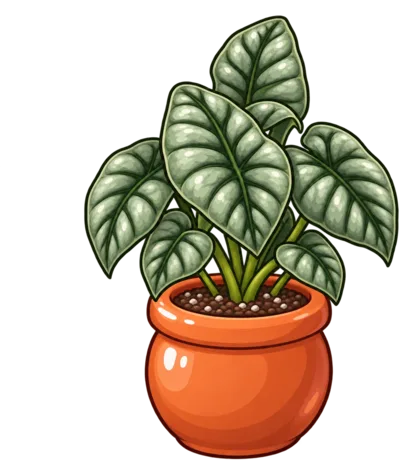
Alocasia Dragon Scale Care (Alocasia baginda): Light, Humidity, Dormancy and Propagation
Alocasia baginda 'Dragon Scale' · Araceae
Thick, textured leaves in silvery green with dark veins, looking a lot like dragon scales. Alocasia baginda ‘Dragon Scale’ is a compact alocasia collectors want for its unusual leaf texture. It grows slowly and needs warmth, humid air and a winter rest.
What is Alocasia Dragon Scale?
‘Dragon Scale’ is a cultivar. NC State Extension lists it as Alocasia baginda ‘Dragon Scale’, while the RHS lists it simply as Alocasia ‘Dragon Scale’, without a species name. The parent species, Alocasia baginda, is native to Borneo (Kalimantan) in the wet tropics, according to Kew’s Plants of the World Online (POWO).
How to recognize it, based on the RHS and NC State Extension:
- Leaves: large, arrow-shaped, thick and textured, dark silvery green with deep dark green veins.
- Leaf undersides: pale silvery white with burgundy-red veins (RHS).
- Size: 1.5–3 feet tall and wide.
- Growth: compact and slow, taking two to five years to reach mature size (RHS).
The silvery look and scaly texture are the plant’s natural pattern, not variegation.
Light requirements
The RHS recommends bright, indirect light. Direct summer sun scorches the leaves, and in low light alocasias grow much more slowly (RHS alocasia guide). An east- or west-facing window works well, or a spot set back from a south window behind a sheer curtain.
Because the leaves reach toward the light, turn the pot a little each time you water (RHS) so the plant doesn’t lean and become unstable.
According to the RHS, compact alocasias like this one suit a smaller warm, humid room such as a bathroom with a window, which also gives it the humidity it wants.
How often to water Dragon Scale
Water freely during the growing season (RHS), but only once the top of the mix has dried; the RHS alocasia guide suggests about 2 inches (5 cm). Never leave water standing in the saucer.
In winter, cut watering to a minimum. Overwatering, especially during dormancy, causes root rot. See our guide to watering houseplants.
Soil and repotting
The RHS recommends a peat-free houseplant mix with added perlite. For better drainage you can add horticultural grit at about one part to three parts mix. More options in our aroid soil mix guide.
Because it grows slowly, it doesn’t need frequent repotting. For alocasias, the RHS suggests repotting in spring about every two years, into a pot only about 2 inches (5 cm) wider. Set the top of the root ball just below the surface.
Humidity and temperature
For alocasias the RHS recommends 60–85°F (16–30°C), with at least 60°F (16°C) in the growing season, and for ‘Dragon Scale’ specifically above 59°F (15°C) year-round. In winter, go slightly cooler and drier, but never below 50°F (10°C). Keep it away from cold drafts, especially in winter.
Humidity should be high. The RHS recommends standing the pot on a tray of moist gravel. A bathroom, grouping plants and a humidifier also help. Dry air browns leaf edges and attracts spider mites. See our houseplant humidity guide.
Fertilizer
From spring to fall, feed with a general liquid fertilizer every 2–3 weeks (RHS). Don’t feed during winter dormancy.
Winter dormancy
Alocasias need a winter rest in cooler, drier conditions (RHS). The plant may drop some leaves, but the rhizome will push out new ones in spring.
In winter:
- water minimally,
- don’t fertilize,
- keep it above 50°F (10°C),
- cut dried leaves off at the base.
How to propagate Alocasia Dragon Scale
For ‘Dragon Scale’ the RHS lists division in spring or summer, stem cuttings in spring, and seed. At home, separating offsets is the most practical route, and the RHS names it the easiest way to propagate alocasias.
- In spring, slide the plant out of its pot.
- Find the offsets, small plants at the base of the mother plant.
- Cut them away with a sharp knife, keeping as much root as you can.
- Pot each one separately in a gritty, peat-free mix.
- Keep them warm and in good light, with the mix just lightly moist.
Alternatively, divide the fleshy rhizome in late spring or early summer. For an overview of techniques, see our houseplant propagation guide.
How to tell Dragon Scale from similar alocasias
Several silvery alocasias are sold, and they can be confused. Going by the RHS and NC State Extension descriptions, look for:
- thick, textured leaves with dark green veins,
- pale, silvery undersides with burgundy-red veins,
- a compact habit that stays under about 3 feet.
Buying tips
The RHS recommends choosing a plant with healthy, unblemished leaves and no wilting or signs of insects. Alocasias are tropical, and cold can damage or even kill them, so keep them wrapped and warm on the way home in cold weather. Let it settle for a while before repotting. Our guide to buying rare houseplants has more tips.
Common problems
| Symptom | Cause | Fix |
|---|---|---|
| Brown leaf edges | dry air | raise humidity; use a pebble tray |
| Leaves yellow and die back in winter | dormancy | water less, don’t feed, wait for spring |
| Mushy base, brown soggy roots | overwatering, rot | let it dry, remove rotten roots, repot |
| Webbing, stippled leaves | spider mites | raise humidity, isolate and treat |
| Clusters of insects on new leaves | aphids | rinse off and treat |
| Chewed leaves | caterpillars | inspect the plant and remove them |
| Scorched patches | direct sun | filter the light or move it back |
The RHS lists aphids and caterpillars as possible pests for ‘Dragon Scale’, and its alocasia guide mentions spider mites in dry air. See our guide to spider mites on houseplants.
Is Alocasia Dragon Scale toxic to pets?
The ASPCA lists the genus Alocasia as toxic to dogs, cats and horses. The toxic principle is insoluble calcium oxalate crystals. Chewing causes oral irritation, pain and swelling of the mouth, tongue and lips, excessive drooling, vomiting and difficulty swallowing.
The RHS notes that the plant is toxic if eaten and irritates skin and eyes, and recommends wearing gloves when handling it. Keep it out of reach of children and pets, and call your vet if you suspect your pet ate some.
FAQ
Where is Alocasia Dragon Scale from?
It is a cultivar of Alocasia baginda, which Kew's Plants of the World Online gives as native to Borneo (Kalimantan), in the wet tropics.
Does Alocasia Dragon Scale grow fast?
No. The RHS describes it as a compact, slow-growing plant that takes two to five years to reach full size.
Why is my Dragon Scale losing leaves in winter?
Alocasias rest in winter and, according to the RHS, may drop some foliage. Water minimally, stop feeding and keep it above 50°F (10°C).
Does Alocasia Dragon Scale need high humidity?
Yes. The RHS recommends high humidity, for example a tray of moist gravel under the pot. Dry air also invites spider mites.
Is Alocasia Dragon Scale toxic to cats and dogs?
Yes. The ASPCA lists the whole genus Alocasia as toxic to dogs, cats and horses.
Sources
- ASPCA — Alocasia (Elephant's Ear)
- RHS — Alocasia 'Dragon Scale'
- NC State Extension — Alocasia
- POWO (Kew) — Alocasia baginda
- RHS — How to grow alocasias
Care information is general; every plant and home is different. Growing is simplified in the game.