 Rare Leaf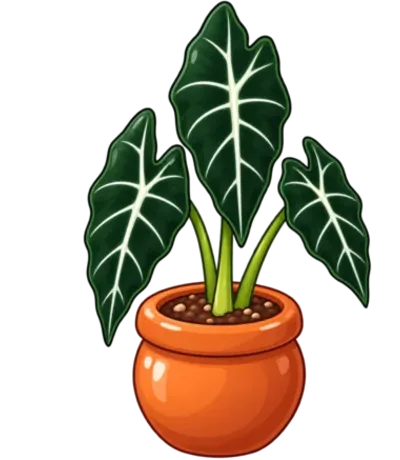
Alocasia Frydek Care (Green Velvet Alocasia): Light, Water, Dormancy and Propagation
Alocasia micholitziana 'Frydek' · Araceae
Narrow, arrow-shaped leaves in deep velvety green, crossed by bright white veins. Alocasia micholitziana ‘Frydek’, often sold as the green velvet alocasia, is one of the most popular alocasias for exactly that look. It needs warmth, humid air, and an owner who doesn’t panic when it rests in winter.
What is Alocasia Frydek?
‘Frydek’ is a cultivated variety. It’s usually listed under the species Alocasia micholitziana, which Kew’s Plants of the World Online (POWO) gives as native to Luzon in the Philippines. The Missouri Botanical Garden, however, describes ‘Frydek’ as a hybrid selection, so its exact origin isn’t settled.
How to recognize it:
- Leaves: arrow-shaped, velvety, dark green with prominent white veins. For A. micholitziana, the RHS lists leaves up to about 16 inches long with wavy edges, on leafstalks up to 18 inches.
- Size: mature plants reach about 3 feet tall and wide (Missouri Botanical Garden).
- Flowers: occasional and not showy, a light green spathe around a creamy white spadix (Missouri Botanical Garden).
- Below ground: a rhizome that sends up leaves on long stalks.
Alocasias belong to the aroid family (Araceae) and are closely related to taro, Colocasia esculenta (RHS).
Light requirements
Give it bright, indirect light. The RHS warns that strong sun scorches the leaves, and that while alocasias can survive in lower light, growth slows a lot. An east- or west-facing window works well, or a spot set back from a south window behind a sheer curtain.
The RHS also suggests giving the pot a slight turn each time you water so the plant doesn’t lean toward the light and become lopsided.
How often to water Alocasia Frydek
From April to October, water once the top 2 inches (5 cm) of potting mix have dried (RHS). If the mix dries out very quickly after watering, the plant is probably root-bound and ready for a bigger pot.
In winter, while the plant is dormant, cut watering to a minimum. Overwatering in general, and especially during dormancy, causes root rot. Our guide to watering houseplants goes deeper on timing.
Soil and repotting
The RHS recommends a peat-free houseplant mix with added perlite, or a peat-free multipurpose mix with horticultural grit at about three parts mix to one part grit for drainage. See our aroid soil mix guide for more options.
How to repot, per the RHS:
- A new plant can usually stay in its nursery pot for about a year, then repot every couple of years in spring.
- Go up only about 2 inches (5 cm) in pot diameter to avoid overpotting.
- Set the top of the root ball just below the surface of the mix.
- Wear gloves, since the sap is an irritant.
Humidity and temperature
Alocasias like it warm. The RHS recommends 60–85°F (16–30°C), with at least 60°F (16°C) through the growing season, and for A. micholitziana specifically, above 59°F (15°C) year-round. In winter give it cooler, drier conditions, but never below 50°F (10°C). Keep it away from cold drafts.
Aim for medium to high humidity. The RHS suggests:
- standing the pot on a tray of gravel with water just below the surface,
- keeping it in a bathroom,
- misting the leaves,
- grouping plants together,
- running a humidifier.
Dry air browns the leaf edges and invites spider mites. See our houseplant humidity guide.
Fertilizer
Feed with a general liquid fertilizer from April to October, following the label (RHS); for A. micholitziana the RHS suggests every 2–3 weeks. Don’t feed during winter dormancy.
Alocasia dormancy in winter
This is where alocasias differ from most houseplants. According to the RHS, they need a winter rest in cooler, drier conditions. The plant may drop some leaves, which is normal, and will push out fresh ones once it starts growing again in spring.
What to do:
- water only minimally,
- stop fertilizing,
- keep it above 50°F (10°C),
- cut dead leaves off at the base.
How to propagate Alocasia Frydek
Alocasias usually aren’t propagated from stem cuttings the way philodendrons are. The RHS names offsets as the easiest route, with rhizome division as the alternative.
Offsets (easiest):
- In spring, look for small plants sprouting around the base of the mother plant.
- Slice them away with a knife, taking as much root as possible.
- Pot each one separately in a gritty, peat-free mix.
- Keep them warm and in good light; new shoots soon follow.
Rhizome division: in late spring or early summer, divide the fleshy rhizome and pot up the pieces.
Always wear gloves. For an overview of techniques, see our houseplant propagation guide.
Variegated Frydek
The white veins on ‘Frydek’ are a natural leaf pattern, not variegation. The RHS does, however, list a variegated form, ‘Freydyk’ (v), whose leaves also carry silvery-white blotches and creamy-white veining. The RHS describes it as slow-growing and compact.
Common problems
| Symptom | Cause | Fix |
|---|---|---|
| Brown, crispy leaf edges | dry air | raise humidity; move to a bathroom or onto a pebble tray |
| Leaves yellowing and dying back in winter | dormancy | water minimally, stop feeding; new leaves come in spring |
| Mushy base, sour-smelling soil | overwatering, root rot | let the mix dry; check and trim rotten roots |
| Scorched patches | direct sun | filter the light or move it back |
| Webbing, stippled leaves | spider mites | raise humidity, isolate and treat |
| White cottony clumps at leaf stalks | mealybugs | remove by hand and treat |
| Plant leaning over | one-sided light | turn it at each watering; put large plants in a heavy terracotta pot (RHS) |
The RHS lists spider mites and mealybugs for A. micholitziana, and the Missouri Botanical Garden adds scale for ‘Frydek’. See our guide to spider mites on houseplants.
Is Alocasia Frydek toxic to pets?
The ASPCA lists the genus Alocasia as toxic to dogs, cats and horses. The toxic principle is insoluble calcium oxalate crystals. Signs after chewing include oral irritation, pain and swelling of the mouth, tongue and lips, excessive drooling, vomiting and difficulty swallowing.
The RHS notes the plant is toxic if eaten and irritates skin and eyes, and recommends gloves when handling. Keep it away from children and pets, and call your vet if you suspect your pet ate some.
In the game
In Rare Leaf Tycoon, Alocasia ‘Frydek’ is one of six species. You propagate cuttings from a stable or unstable mother line and only see a new leaf’s pattern after it’s revealed. Growing is simplified in the game, and plants never die.
FAQ
Why is my Alocasia Frydek dropping leaves in winter?
Alocasias go dormant in winter. The RHS says they may lose some foliage during this time and that it is nothing to worry about. Water very little and stop feeding.
How often should I water Alocasia Frydek?
From April to October, water once the top 2 inches (5 cm) of soil are dry. In winter cut watering to a minimum, because soggy soil during dormancy rots the roots.
What is the lowest temperature an Alocasia can handle?
The RHS recommends keeping alocasias above 60°F (16°C) in the growing season and never below 50°F (10°C). For A. micholitziana it advises staying above 59°F (15°C).
How do you propagate Alocasia Frydek?
The easiest way is to separate the offsets (pups) that form around the base in spring. You can also divide the rhizome in late spring or early summer.
Is Alocasia Frydek toxic to cats and dogs?
Yes. The ASPCA lists the genus Alocasia as toxic to dogs, cats and horses. It contains insoluble calcium oxalate crystals.
Sources
- ASPCA — Alocasia (Elephant's Ear)
- RHS — Alocasia micholitziana
- RHS — Alocasia micholitziana 'Freydyk' (v)
- Missouri Botanical Garden — Alocasia 'Frydek'
- RHS — How to grow alocasias
- NC State Extension — Alocasia
- POWO (Kew) — Alocasia micholitziana
Care information is general; every plant and home is different. Growing is simplified in the game.