 Rare Leaf
Monstera Thai Constellation vs. Albo: How to Tell Them Apart and Which to Buy
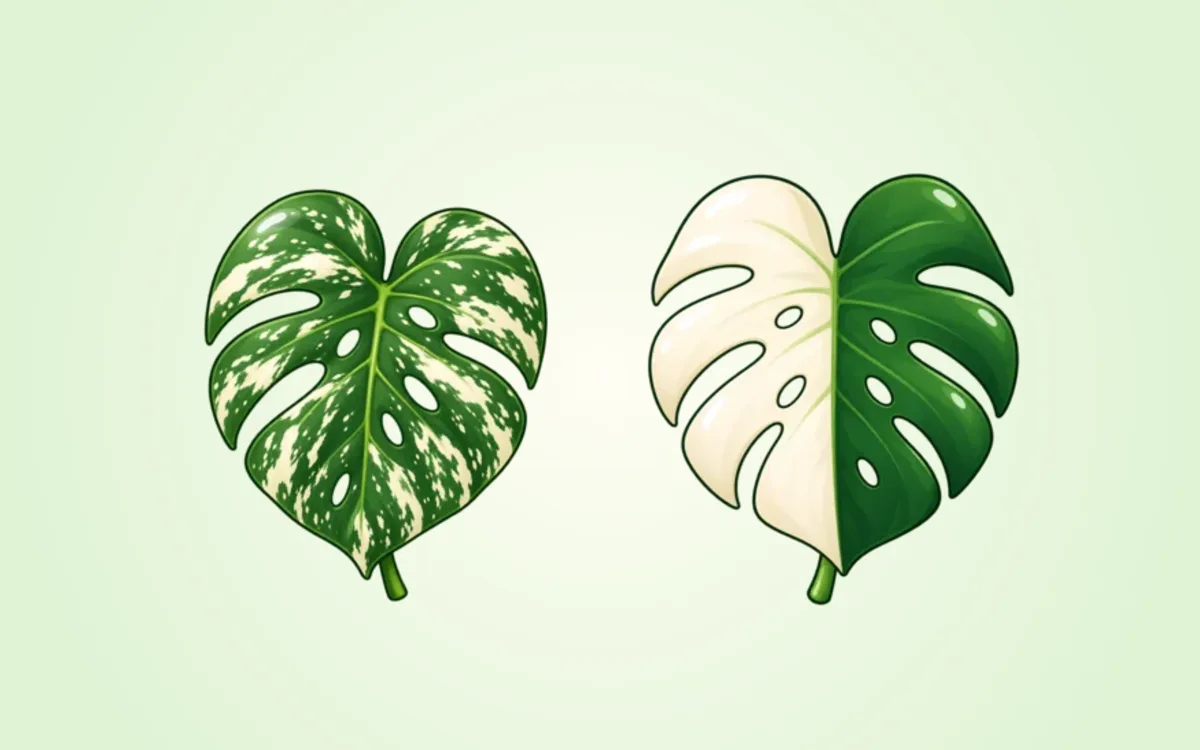
At first glance they’re both just “white Monsteras.” In reality, Monstera deliciosa ‘Thai Constellation’ and Monstera ‘Albo’ are quite different plants. They have different patterns, different histories, different temperaments, and often very different price tags. If you’re thinking about buying a variegated Monstera, this is the difference worth understanding before you pay.
Thai Constellation vs. Albo at a glance
| Thai Constellation | Albo (‘Albo Variegata’) | |
|---|---|---|
| Pattern | creamy speckles and splashes across the whole leaf | bright white sectors, streaks, half-moons |
| Leaf to leaf | fairly similar | can change completely |
| Stability | generally regarded as predictable | unstable chimera, prone to reverting or going all-white |
| How it’s multiplied | mostly tissue culture labs | mostly cuttings from variegated mother plants |
| Main risks | slow growth, sunburned cream areas | green reversion, weak all-white growth |
| Availability | sold by large growers | scarcer, depends on each cutting |
What Thai Constellation looks like
The RHS describes ‘Thai Constellation’ as having deep green leaves “splashed and streaked with creamy white”. The effect is a night sky: fine speckles and larger splashes scattered across the whole surface of the leaf, sometimes merging into bigger patches. The color is cream rather than snow-white, which is one of the easiest ways to tell it apart from Albo in photos.
Where it came from
There’s a lot of myth around this plant. Costa Farms, which introduced it to the US market at the TPIE trade show in 2020, says Thai Constellation is believed to be a naturally occurring mutation. People often say it was “created in a lab.” According to Costa Farms, that misunderstanding comes from the fact that it’s most frequently propagated in tissue culture labs.
Tissue culture is also why it’s more widely available than Albo. A lab can multiply plants from tiny pieces of tissue far faster than anyone can take cuttings. It isn’t effortless, though. Costa Farms has openly said Thai Constellation has quirks that made it hard to produce the tens of thousands of young plants they needed from tissue culture. For more on how this works, see our houseplant tissue culture guide.
How stable is it?
Growers and sellers generally describe Thai Constellation as a stable variegation, meaning new leaves keep a similar speckled look and plants don’t tend to flip between extremes the way Albo does. We couldn’t find a botanical source that explains why at the cell level, so treat claims that it “can never revert” with some caution. What you can count on is that when you buy one, you have a reasonable idea of what the next leaves will look like.
What Monstera Albo looks like
Albo is a chimera: the plant contains cells that can make chlorophyll and cells that can’t, growing side by side. The University of Illinois Extension describes the sectorial type of chimera as unstable, able to produce normal shoots, mutated shoots, and mixtures. That matches what Albo owners see. One leaf has a fine white streak, the next is half white (the famous half moon), and the next is almost entirely green.
That’s both the appeal and the risk:
- every leaf is one of a kind, which is why collectors love it,
- the plant can revert and start producing all-green leaves,
- leaves with no green at all look amazing but can’t feed the plant, and they tend to brown over time.
Albo is multiplied mainly from cuttings that carry the variegation, and each mother plant yields only a few good ones. The RHS notes that variegated forms such as ‘Variegata’ and ‘Albo-Variegata’ are particularly sought after, much harder to find than the green species, and more expensive as a result.
How to tell them apart when shopping
- Color: cream and speckled suggests Thai Constellation. Bright white blocks, stripes, or halves suggest Albo.
- Consistency: look at several leaves. If they all share a similar speckled look, it’s probably Thai Constellation. If each one is wildly different, it’s probably Albo.
- Stem: Albo stems often show white or striped sections. On Albo, the variegation at the node is what matters for future growth.
- Label and seller: Thai Constellation is sold by large growers such as Costa Farms. Albo is more often sold as rooted cuttings or individual plants by specialist sellers.
Care: what they have in common
Both are forms of Monstera deliciosa, so the basics are the same as for the green species:
- Light: bright, indirect light. The RHS suggests an east- or west-facing window and warns that direct sun can scorch the leaves. Costa Farms recommends placing Thai Constellation within about 3 feet of an unobstructed east- or west-facing window. The pale areas scorch more easily than green ones.
- Water: the RHS advises letting the compost get almost dry before watering thoroughly. Costa Farms suggests watering Thai Constellation when roughly the top half of the mix feels dry. Either way, avoid keeping it wet, and water less in winter.
- Temperature and humidity: the RHS gives 18–25°C (65–77°F). Costa Farms says Thai Constellation is happiest above about 55% relative humidity. See our humidity guide.
- Support: Monstera is a climber. The Missouri Botanical Garden notes that without a pole or trellis it tends to grow sideways. A moss pole helps it grow upward and produce larger, more mature leaves.
- Soil: a chunky, well-draining aroid mix. See our aroid soil mix guide.
Extra care for Albo
- Green shoots: the RHS recommends removing reverted shoots or cutting back to growth that still shows variegation. On Albo, that means cutting above the last well-variegated leaf.
- Too much white: a plant producing mostly white leaves grows slowly and can decline. Some growers cut back to a node with more balanced variegation.
- Light: Albo has less green tissue to work with, so it’s especially important to give it plenty of bright, indirect light.
Extra care for Thai Constellation
- Patience: Costa Farms describes it as starting small and slowly growing into a large plant, with leaves that can eventually be more than 2 feet across.
- Sunburn: the cream speckles brown quickly in harsh direct sun.
What to watch out for when buying
- A cutting without a node (just a leaf) will not grow into a new plant. Don’t pay plant prices for a leaf. Our Monstera propagation guide explains what a viable cutting looks like.
- Albo nodes: check the variegation on the stem at the node. A completely green node will most likely grow green.
- One perfect leaf proves nothing. A photo of one beautiful half-moon doesn’t mean the next leaf will look like it, especially with a chimera.
- Tissue-culture plantlets are tiny and need time. That’s fine, as long as the listing is clear about size.
More tips are in our guide to buying rare houseplants.
Is Monstera toxic to pets?
Yes, and variegation doesn’t change that. The ASPCA lists Monstera deliciosa as toxic to cats and dogs because it contains insoluble calcium oxalates, which cause mouth irritation, drooling, vomiting, and difficulty swallowing. The RHS also warns that it’s a skin and eye irritant, so wear gloves when you prune.
For more on the species itself, see our Monstera deliciosa profile and our overview of variegated houseplants.
In the game
In Rare Leaf Tycoon, Monstera deliciosa ‘Thai Constellation’ is one of the higher-tier species you unlock. The game simplifies things. For each species, you pick a stable or an unstable mother line. The stable line reliably gives the marbled pattern, while the unstable line gives a better chance at a rare half-moon and a higher risk of a plain green leaf. In real life, that kind of gamble is more of an Albo thing. Every pattern you find goes into your herbarium.
FAQ
How can you tell Thai Constellation from Albo?
Thai Constellation has creamy speckles and splashes scattered across the whole leaf, and the look stays fairly similar from leaf to leaf. Albo has bright white sectors, streaks, or whole white halves, and each leaf can look completely different.
Which is more stable, Thai Constellation or Albo?
Growers generally treat Thai Constellation as the more predictable of the two, while Albo is known for switching between heavily white, balanced, and mostly green leaves. Albo growers regularly prune out green or all-white growth to keep the plant balanced.
Is Thai Constellation made in a lab?
Not exactly. Costa Farms, which sells it in the US, says it is believed to be a naturally occurring mutation. It is most often multiplied in tissue culture labs, which is where the lab-made myth comes from.
Why is Monstera Albo usually more expensive?
Albo is multiplied mainly from cuttings that carry variegation, so each mother plant yields only a few. Tissue culture lets labs produce Thai Constellation in larger numbers. Prices for both depend heavily on size and leaf pattern.
Can Thai Constellation produce a half-moon leaf?
An unusually heavily variegated leaf can appear now and then, but the classic half-moon split is associated with sectorial, chimeral variegation of the Albo type.
Sources
- RHS — Monstera deliciosa 'Thai Constellation'
- RHS — Monstera deliciosa
- RHS — How to grow Swiss cheese plants
- Costa Farms — Thai Constellation Monstera
- Costa Farms — Monstera Thai Constellation update
- Missouri Botanical Garden Plant Finder — Monstera deliciosa
- University of Illinois Extension — Chimeras (Home, Yard & Garden Newsletter)
- RHS — Reversion in plants
- ASPCA — Swiss Cheese Plant
Care information is general; every plant and home is different. Growing is simplified in the game.